✨   New AI Features    |   🎉 New Mobile App
✨  Meet Sortd AI & the Agent API — smart triage, drafts & follow-upsread more    |     🎉  The new Sortd mobile app is here learn more
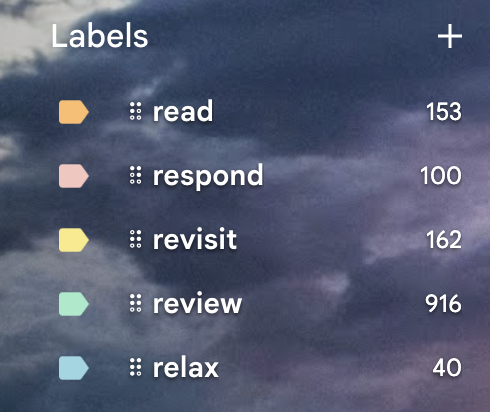
Gmail sidebar showing the AI Inbox Labels: read, respond, revisit, review, relax
September 22, 2026

AI Inbox Labels: The 5R System for Your Gmail Inbox

AI Inbox Labels automatically sorts every message in your Gmail inbox into one of six folders — Read, Respond, Revisit, Review, Relax, and R.I.P. — so you always know what needs your attention.

If your inbox is a mix of things you need to reply to, things you're waiting on, and things you can safely ignore, sorting that out by hand every morning gets old fast.

That's exactly what AI Inbox Labels is built to fix. It's a new Sortd AI feature that reads your Primary Gmail inbox and automatically labels every conversation with what it actually needs from you — right inside Gmail, no separate app or tab required.

The 5Rs: six labels for every message

Every message in your Primary inbox gets sorted into one of six folders, based on a simple framework we call the 5Rs:

  • Read — you should know about this, but no reply is expected.
  • Respond — someone's expecting a reply: a question, a request, a decision.
  • Revisit — the conversation's still open. You've already replied, or you've deferred it.
  • Review — system or automated messages: notifications, receipts, alerts.
  • Relax — the conversation is finished. Nothing more to do.
  • R.I.P. — marketing, newsletters, and sales outreach you can safely ignore.

Each label shows up as a real Gmail label, so you can see it, filter by it, or search it exactly the way you would any other label in Gmail.

Secondary tags add extra context

On top of the primary label, some messages also get a secondary tag:

  • Urgent — on a Respond message with clear urgency
  • Time sensitive — on a Read message tied to a deadline or date
  • Waiting — on a Revisit message where you've handed the ball to someone else
  • Pinned (waiting on me) — on a Revisit message where you said you'd get back to it

How it decides

Classification looks at more than just the subject line. It takes into account:

  • Whether the message is addressed to you personally, or you're one of several recipients
  • Whether you're the only "To" recipient or just CC'd
  • Whether you've already replied, and what state that leaves the thread in
  • Whether the sender looks automated — system notifications, no-reply addresses
  • The wording and intent of the message itself

You're in control

AI Inbox Labels is opt-in. Once it's turned on for your account:

  • Labels are applied automatically as new mail arrives — no ongoing setup needed.
  • It works back through your recent inbox the first time it's turned on, so your existing mail gets caught up too.
  • Any of the six folders or four secondary tags can be individually switched off in your settings — messages simply won't be tagged with the ones you've turned off.
  • It only looks at your Primary inbox — not Social, Promotions, or any other Gmail tab you haven't enabled it for.

A quick example

Say a client emails asking you to confirm a meeting time. That lands in Respond. You reply and say you'll circle back with your availability — the thread becomes Revisit, tagged Pinned (waiting on me), since you're the one who owes the next move. Once you've sent your availability and they've confirmed, it moves to Relax — nothing left to do.

Frequently asked questions

Do I need to set anything up?

No. Once AI Inbox Labels is turned on for your account, labels are applied automatically to new mail as it arrives, and to your recent inbox history the first time it runs.

Can I turn off labels I don't want?

Yes. Every folder and secondary tag can be switched off individually in your settings.

Does this affect other Gmail tabs like Promotions or Social?

No — AI Inbox Labels only classifies mail in your Primary inbox (or any Gmail tab you've specifically enabled it for).

Get started

Have questions about AI Inbox Labels, or want to turn it on for your account? Reach out to our team — we're happy to help.

Written by
Rodney Kuhn